Deodorize, sanitize or disinfect: what does your trash can need?
Lots of companies say they “sanitize” or “disinfect” trash cans. Those words have legal meanings. Here's what each one means, what a product has to prove before it can use them, and why we're careful about which words we use.
See trash can cleaningThe short version
| What it does | Who can claim it | |
|---|---|---|
| Deodorize | Removes or breaks down the source of odors | Any odor-control product |
| Sanitize | Reduces bacteria on a surface to a safer level | Only EPA-registered sanitizers, used as the label directs |
| Disinfect | Kills nearly all of the germs listed on the label | Only EPA-registered disinfectants, used as the label directs |
The law behind the words
Under federal pesticide law, any product that claims to kill or reduce germs on surfaces has to be registered with the EPA, and it carries an EPA registration number on its label. Without that registration, a product can't legally say it sanitizes or disinfects, no matter how strong it smells.
The bar is also different for each word. For surfaces that don't touch food, like a trash can, EPA's standard for a sanitizer is reducing bacteria by at least 99.9% within 5 minutes. A disinfectant has to destroy at least 99.999%. And both only work when you follow the label: the right dilution, on a surface that's already been cleaned, and kept wet for the full contact time. Some disinfectants need 10 minutes.
Deodorizing: what most cans need every month
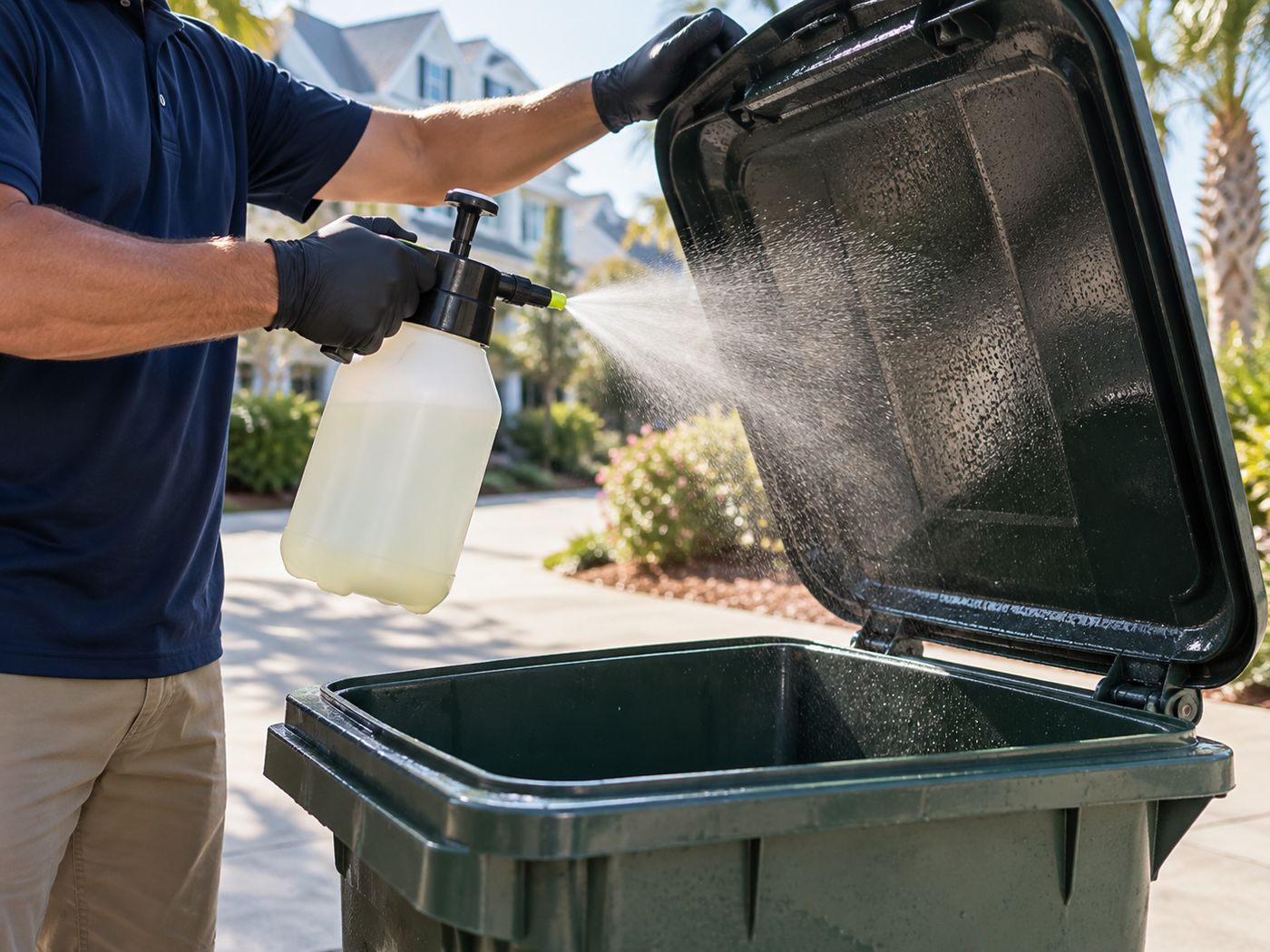
Trash can smell comes from food and liquids rotting on the plastic. Enzyme and bio-based odor products break that residue down, so the smell goes away instead of being covered up. That's what our monthly Deodorize & Refresh does: an enzyme odor-control spray and a wipe of the lid and handle. It's odor control, and we never call it sanitizing.
Sanitizing: what a real deep clean adds
To sanitize a trash can properly, you first have to clean it, because sanitizers can't work through a layer of grime. That's why our Hot Water Wash & Sanitize starts with 200°F water to wash the can inside and out, then applies an EPA-registered sanitizer, used according to its label, that kills 99.9% of bacteria and viruses. All of it happens inside our trailer, with every drop captured (see storm drain rules for washing trash cans).
Disinfecting: usually not the goal
A trash can gets dirty again the moment the next bag goes in, so a hospital-level disinfecting claim doesn't buy you much. What matters is getting the can clean, keeping the smell and flies down, and doing it regularly. Be wary of anyone who promises a germ-free trash can.
How to check any product's claim
- Look for an EPA Reg. No. on the label. No number, no germ-killing claim.
- Read the directions for the contact time and dilution. Spray-and-wipe in seconds usually isn't enough.
- Never mix cleaners. Bleach mixed with ammonia or acids makes toxic gas.
- Don't mix enzyme deodorizers with sanitizers at the same time: the sanitizer stops the enzymes from working.
Trash can valet near you: trash can valet in Southport · St. James trash can service · Oak Island trash can valet
More local guides: Southport trash & recycling schedule · St. James trash & recycling schedule · Oak Island trash & recycling schedule by zone · All guides
Common questions
Does an enzyme spray sanitize a trash can?
No. Enzyme sprays are odor control. They break down the residue that causes smells. Only an EPA-registered sanitizer, used as its label directs, can claim to sanitize.
What's the difference between sanitizing and disinfecting?
For surfaces that don't touch food, an EPA sanitizer must reduce bacteria by at least 99.9% within 5 minutes. A disinfectant must destroy at least 99.999% of the germs on its label. Both must be EPA-registered.
How do I know if a cleaner is EPA-registered?
Look for an EPA registration number (EPA Reg. No.) on the label.
Which Deckhand service sanitizes?
Only the Hot Water Wash & Sanitize, which uses 200°F water and an EPA-registered sanitizer that kills 99.9% of bacteria and viruses. Our monthly Deodorize & Refresh is odor control.